

What happens in the jar
A darker jar than last year.
The same variety looks darker a year on than it did when it was bought. Here is where that comes from, how much of it is down to the sun, and when a dark colour really does mean something.
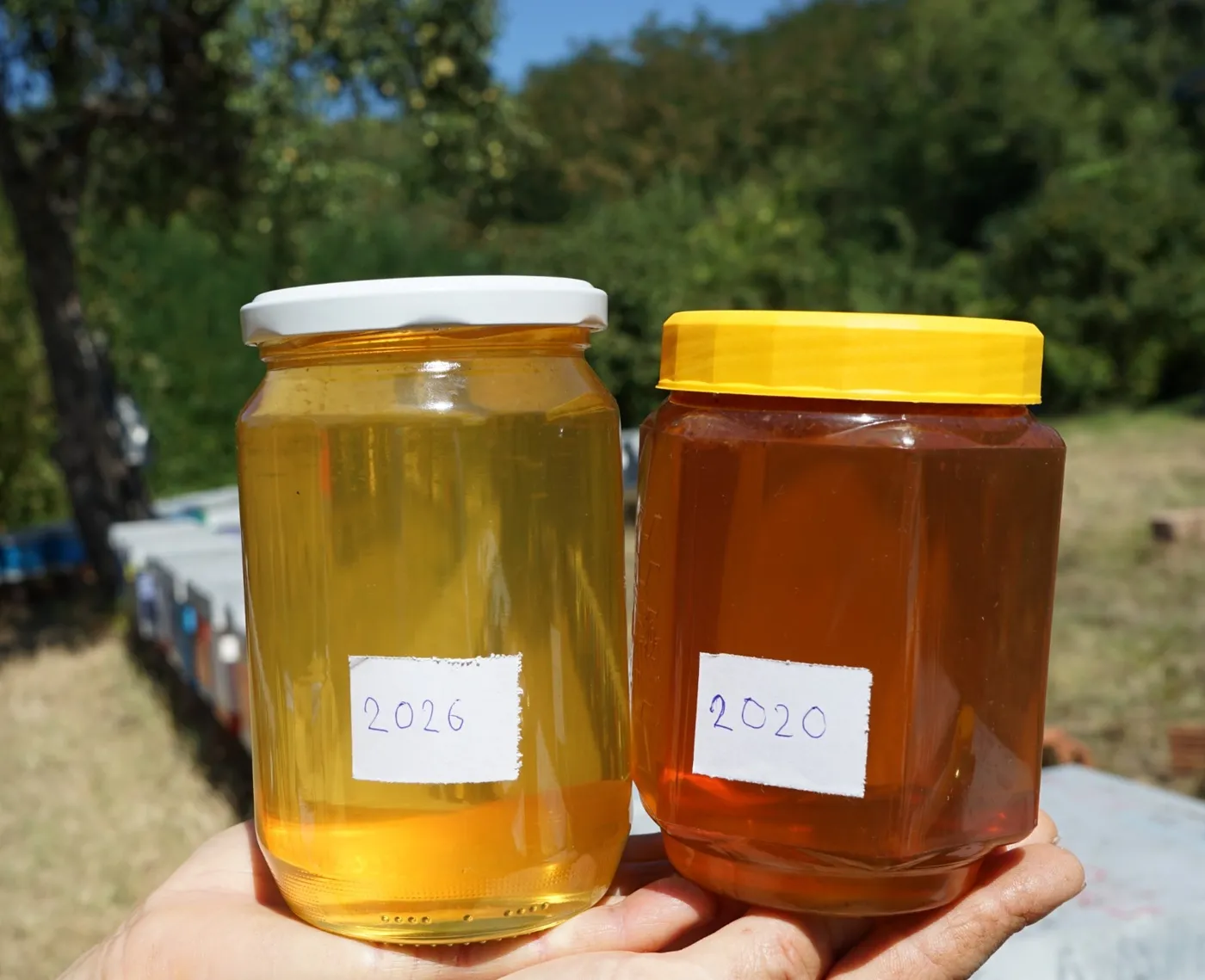
The change is easiest to see with two jars of the same variety from two seasons side by side. The newer one is lighter, the older goes towards amber or brown. The honey is entirely sound.
A slow reaction, over years
Besides sugars, honey contains amino acids from pollen and from the bees themselves. Sugars and amino acids react slowly with one another and build dark-coloured compounds. The same reaction colours toasted bread and roasted meat, except that in a jar it runs at room temperature and takes months instead of minutes.
HMF rises alongside that darkening, the number a laboratory uses to see how old honey is or how much it was heated. Colour and that number move in the same direction, so darkening is a sign that honey has stood, not that it has gone off.
Darkening shows how long the honey stood and how warm it was kept.
What speeds darkening up
| Condition | Effect |
|---|---|
| Heat | The strongest. A jar above the stove or by a radiator darkens in months as much as another does in years. |
| Direct sun | Warms the jar and breaks down enzymes. Glass also lets through part of the ultraviolet. |
| Time | It works at twenty degrees too, just slowly. |
| Variety | Honey with more minerals darkens faster, so honeydew goes before acacia. |
Does the sun spoil honey
The sun does not spoil honey in the sense of making it unusable, but it does three things that do it no favours. It warms the jar, breaks down the enzymes the bee put in, and speeds up darkening. A jar that spent a summer on the windowsill has lost part of what honey is taken off the apiary for in the first place.
The remedy is simple and is set out in the note on storing honey: a closed jar, room temperature, a shelf the sun does not reach directly.
When honey is nearly black from the start
There is also a darkness that has nothing to do with storage. Forest honey, honeydew honey, is dark already at extraction because it comes not from blossom but from the honeydew aphids leave on oak, maple and hornbeam. It holds more minerals, which is measured as a higher electrical conductivity, and that is how such honey is formally told apart from blossom honey.
A jar of our forest honey is dark from day one, while acacia is nearly colourless. Comparing dark honey with light honey tells you where they came from, not how old they are.
When the colour is a reason to ask
It is worth paying attention only if something else appears along with the change in colour: foam on the surface, bubbles rising, or a sour smell. That is fermentation rather than darkening, and it comes from moisture that got into the jar. There is more on that, and on why the date on the jar does not mean what people assume, in the note on the shelf life of honey.
A darker colour without any of those signs means the jar has stood. Honey like that is eaten as normal.
Why it sets at the same time
Darkening and crystallisation often go together simply because both take time. Crystallisation comes from glucose leaving the solution and has nothing to do with colour, and the whole mechanism is described in the note on crystallisation.