


The question we get most
The honey has set. That is normal.
Every winter brings the same question: the honey has gone solid, has it gone off? Below is why it happens at all, how fast in each variety, and what to do if you would rather have it runny.
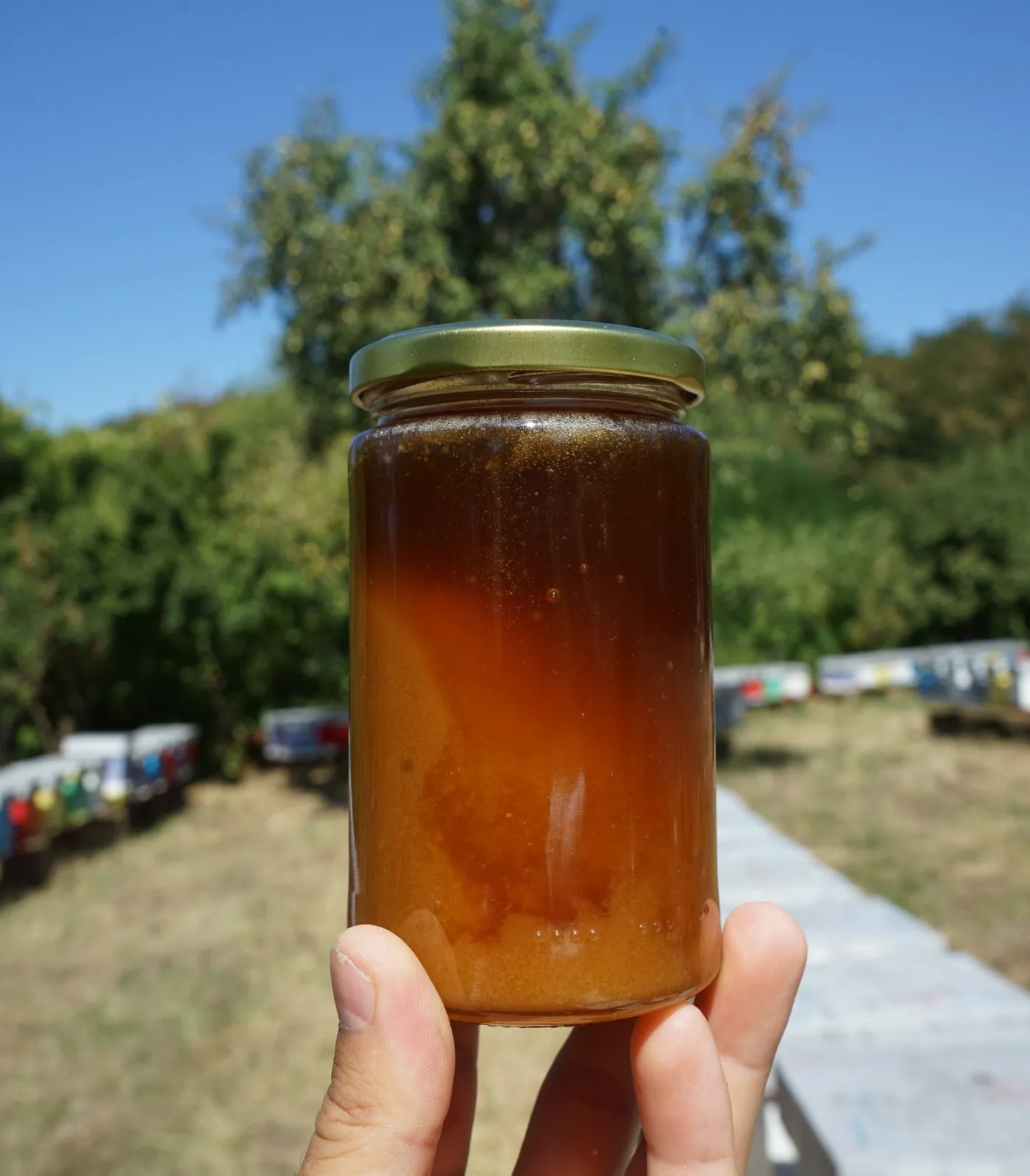
The question usually arrives in January or February, when a jar bought in October is suddenly no longer clear but thick, paler and grainy.
Crystallisation is the ordinary state of honey and it happens to every real honey, only at different speeds. Honey that stays perfectly clear for years is the one that ought to raise a question.
What is actually happening
Honey is mostly two sugars, glucose and fructose, in far less water than they need to stay dissolved. That is an unstable state, and sooner or later the glucose comes out of solution as fine crystals, turning the honey from runny to thick.
The composition does not change. The form does.
Crystallised honey is the same honey, with its glucose now in solid form. Bring it back to liquid and you get what you had.
Why one variety arrives clear and another set
It all depends on the ratio of those two sugars, and that ratio comes from the blossom. Hence the difference between our three varieties, which do not set at the same rate.
| Variety | When it sets | Why |
|---|---|---|
| Acacia | Stays clear for up to a year | The most fructose of the three |
| Vlasina | Three to six months | Meadow and honeydew together, finer grain |
| Forest | Three to six months | A high level of glucose and melezitose |
If your acacia honey is still clear after ten months, nobody has done anything to it. That is acacia. And if the Vlasina set before the new year, that is Vlasina behaving as it should.
Crystals are not the same in every honey
It is worth looking at how it sets, too. Some honey gives a coarse, sandy grain, some sets into something almost creamy. Vlasina goes to a finer grain than pure meadow honey, because it carries a share of honeydew that speeds crystallisation up.
Neither is a fault. It is simply what the bees brought in that summer.
What to do if you would rather it were runny
The short answer is nothing, and plenty of people prefer it set, because it spreads more easily and does not run off the bread. If you do want it liquid, there is exactly one right way.
- Stand the closed jar in warm water that is no hotter than 40 °C.
- Leave it there, stirring now and again. It takes longer than you would like.
- Repeat if you need to, rather than raising the temperature.
Never the microwave and never straight on the hob. Above forty degrees honey starts to lose exactly what makes it worth buying from an apiary. The same rule applies at our end: the honey is never warmed above 40 °C at any step, so it would make no sense to break that in a kitchen.
One more thing that is easy to miss: once you have brought honey back to liquid it will set again, usually faster than the first time. That is fine. Warm only as much as you will get through.
How to slow it down, if you insist
Crystallisation is fastest at around fourteen degrees, which is roughly an unheated hallway, so a jar left in the fridge or in a cold larder sets long before the same jar on a kitchen shelf.
Keeping honey at room temperature, in a closed jar and out of the sun, is the only thing that genuinely helps. We wrote about that separately, because it is bound up with the one mistake that really can harm honey: how to store honey.