

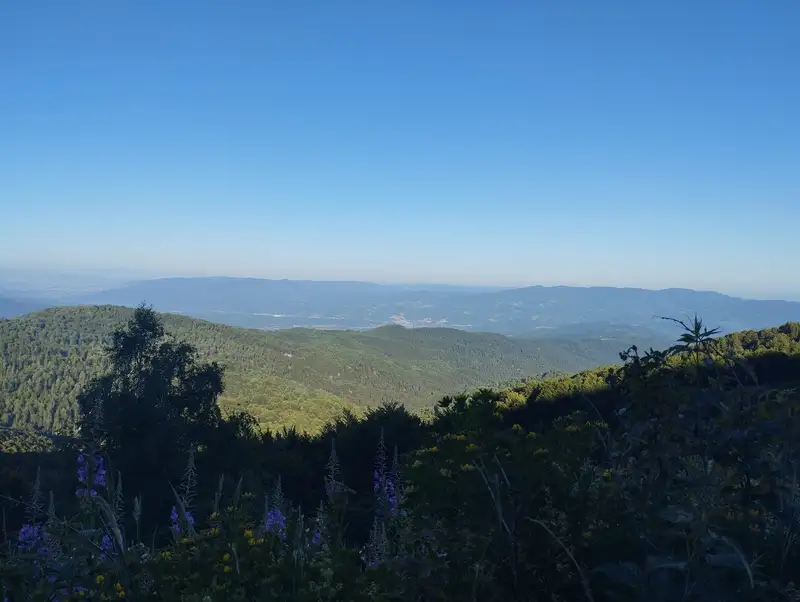
How migratory beekeeping works
The same acacia, taken twice.
Our hives do not stand in one place. Three times a season they go higher, up the river Vlasina, and that is the reason three separate varieties exist at all.
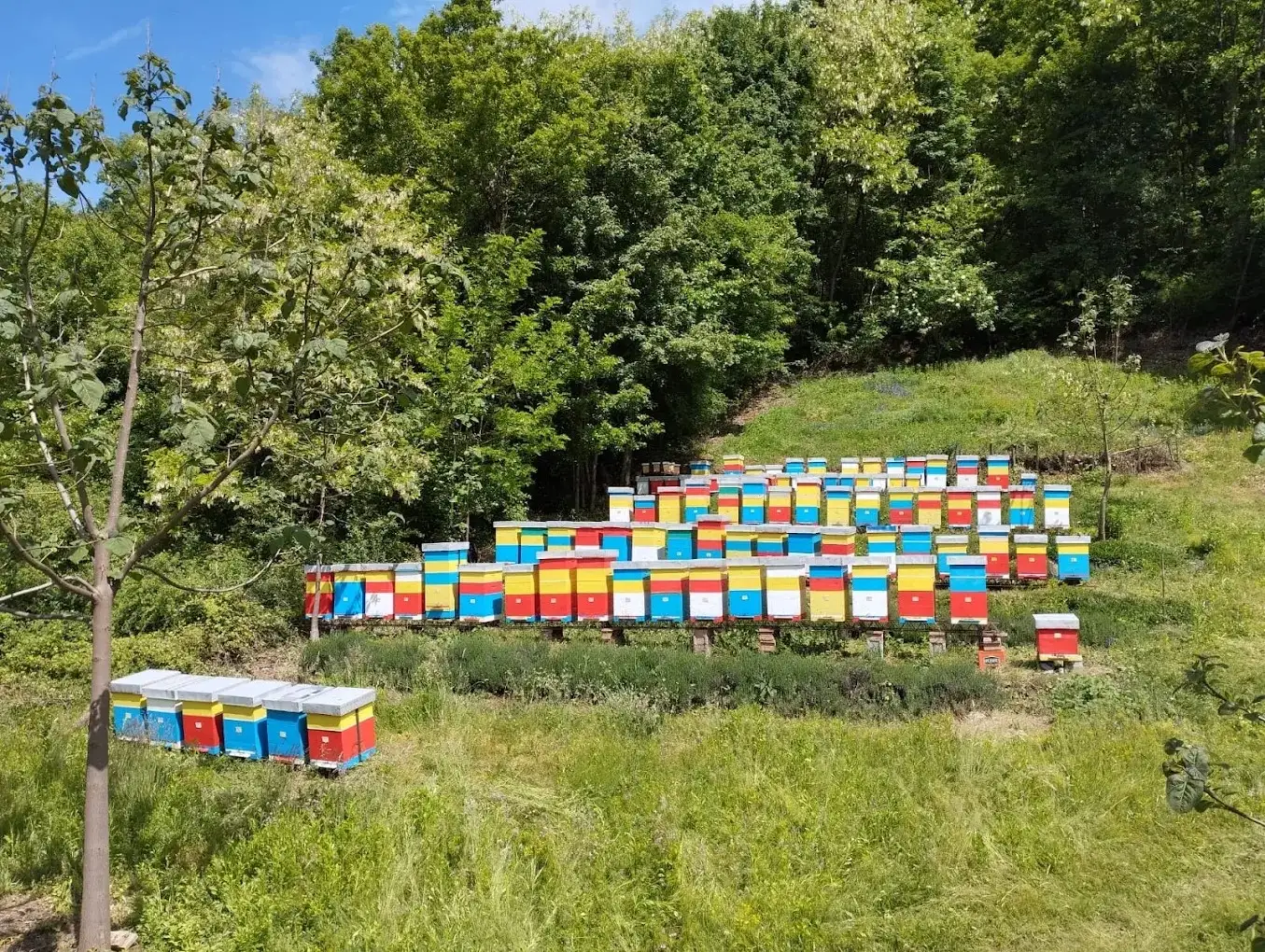
If the hives stayed in one place there would be ten days of acacia a year. That is how long the bloom lasts. After that, at that altitude, there is nothing left to take.
Three stops in one season
Over a season our hives move three times, each time higher, and all three stops lie along the Vlasina, one above the other.
| Stop | Altitude | When | What is taken |
|---|---|---|---|
| Vlasotince | about 270 m | late April | The first acacia |
| Svođe | about 500 m | mid May and July | The same acacia again, then honeydew |
| Slopes of Čemernik | about 1,200 m | June to August | Vlasina |
The altitudes are rounded. Exact heights were never measured, and false precision is no better than a wrong figure, so we do not write them to the metre.
The fortnight that moving buys
This is the whole idea. The same blossom runs late at higher altitude. Acacia at Vlasotince, around two hundred and seventy metres, flowers first. Two hundred and thirty metres higher, at Svođe, the same acacia starts roughly a fortnight later.
A hive moves thirty kilometres and gets a second spring.
For the bees it is simply the same flow continuing. For us it is the difference between ten days of acacia and nearly three weeks. Both end up in the same variety, because both are acacia honey, taken at two stops.
What the move itself looks like
It is done at night. That is not habit but necessity: hives move only once every bee is inside.
Loading can take up to three hours. The entrances are closed only after the last bee is back, because one left behind does not know where its hive has gone and is lost. So nothing is hurried and nothing moves before dark.
In the morning the colony wakes in a place it does not know, flies out and orients itself again. That costs the bees a few days of strength, which is why the hives are not moved more often than makes sense.
What the third stop gives
On the slopes of Čemernik, at around 1,200 metres above sea level, the same hive gives far less honey than at lower altitudes. The weather is colder, the flow less certain, and looking after the bees takes more.
Even so, it is from there that a honey comes which cannot be had any lower. Meadow and forest alternate over a small area, so the bees gather nectar from flowers and honeydew at the same time. That is how Vlasina honey comes about. Once the flowers stop yielding and the oak and maple honeydew remains, the result is forest honey.
Three extractions, not one
Because the honey is gathered in three places and three periods, the extraction is separate too. No jar holds two flows.
That is why our varieties differ enough to be told apart by colour, and why nothing is blended after extraction. If it all ran into the same tank you would get one average honey, and the story about three stops would mean nothing.