


Before you buy
A glass of water tells you nothing.
Every forum carries the same list of tricks for checking honey at the kitchen table. Not one of them separates real honey from sugar syrup, and here is what sits behind each of them and what can be looked at instead.
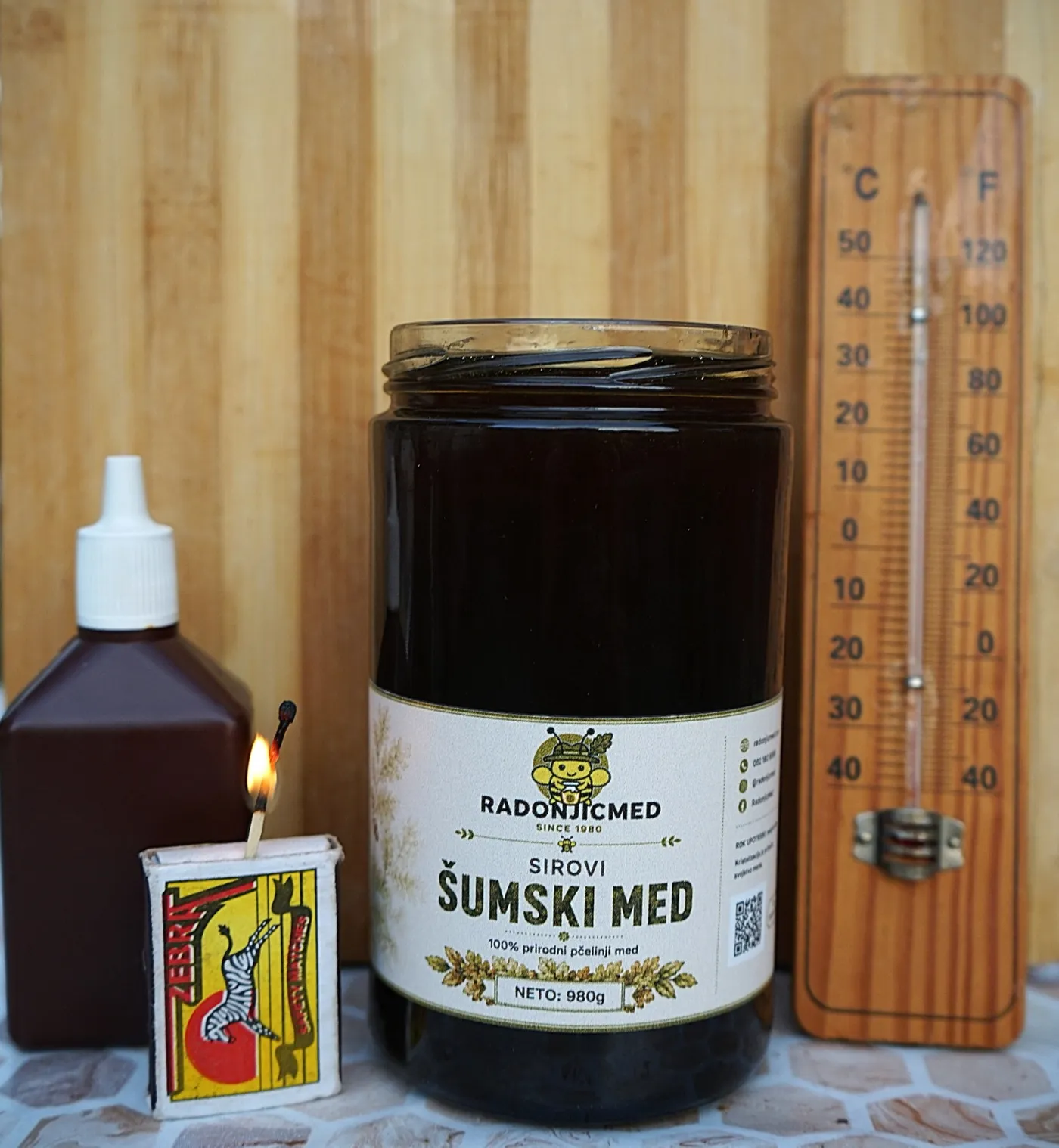
The question almost always comes up once the jar has been bought. The honey looks different from last time, thicker or lighter or set solid, and the buyer starts looking for a way to check what they actually got. The list of kitchen tests that surfaces has not changed in twenty years and travels from forum to forum.
Five common checks
They are worth going through one by one, because each has a reason for sounding convincing.
| Test | The claim | What actually happens |
|---|---|---|
| A drop in a glass of water | Real honey sinks in one lump, fake honey disperses | How the drop behaves depends on density and on how much water the honey holds, and that differs between varieties and between years. Thick honey sinks in a lump even when it has been cut with syrup. |
| A drop on the thumb | Real honey holds, fake honey runs | This measures viscosity and nothing else. Acacia honey with slightly more water runs more easily than dense honeydew, and both are real. |
| A match or lit cotton | Real honey burns, fake honey does not | Sugar burns, and syrup is sugar. What lights is essentially a wick soaked in anything sweet. |
| A drop on paper | Real honey does not soak through | Any honey with slightly more water soaks through, and that is a question of variety and of when it was extracted. |
| Iodine | It turns blue if the honey is fake | Iodine detects starch. Honey was adulterated with starch half a century ago, and today's corn and rice syrups contain none, so the test stays clear. |
Every one of these measures density or the presence of sugar. Honey is both.
They share one mistake: they compare honey against an imaginary variety that is always the same thickness and the same colour. No such variety exists. Acacia and honeydew differ in almost everything these tests measure, although both came out of the same hive two months apart.
What can genuinely be checked
Adulteration is proved reliably only in a laboratory, by methods that measure carbon isotope ratios or the sugar profile. That is expensive and makes no sense for a single jar. What remains is a handful of things a buyer really can look at.
The label
The jar should say who produced the honey and where, how much of it there is, and the date up to which it is recommended. When there is a trade name behind the product rather than a name and a place, the buyer has nobody to ask when a question comes up.
A realistic price range
Local honey in Serbia runs roughly from nine hundred to two and a half thousand dinars a kilogram, depending on the variety and on how it is sold. A jar well below that range means somebody in the chain is working for nothing, which rarely happens. Our prices, with the per-kilogram figure, are on the price list.
How it behaves over winter
Honey that stays perfectly clear for years at room temperature is stranger than honey that sets. Crystallisation comes from glucose and happens to every real honey, only at different speeds, which is covered in the note on crystallisation. Syrup does not behave that way.
A known origin
The simplest check is to ask where the honey is from and off which flow, and whether there is an answer. A beekeeper who moves hives knows where they were and when they extracted, so it can be told. Our route from Vlasotince to Čemernik is described on the page about the mountain, and what a year on the apiary looks like in the apiary through the year.
What colour and thickness do not mean
Darker honey is often taken as a sign of something stronger or better, and the colour comes from the flow. Acacia is nearly colourless because it comes off acacia blossom, honeydew honey is almost black because it comes off honeydew on oak and maple. Comparing two varieties by colour tells you where they are from, not what they are worth.
The same goes for thickness. Freshly extracted honey is thinner than honey that has stood a few weeks, and honey from a wet year carries slightly more water than the same honey from a dry one. All three of our varieties and how they differ sit side by side on the honeys page.
If the jar is already bought
When a doubt comes up about honey that is already in the house, the one useful thing is to ask the seller where it is from and how it was extracted. The answer, or the absence of one, says more than any test with a glass of water.